QueryPilot's correction loop moved execution success from 63 to 67 queries on the 70-query core set.
70 core benchmark queriesVerified 2026-08-28Case 06 / Text-to-SQL system
QueryPilot
QueryPilot turns a question into read-only SQL only after schema retrieval, static criticism, database execution, and one bounded correction path have all had a chance to reject it.
- Role
- AI engineer
- Built at
- Personal project
- Contribution
- Retrieval, generation, validation, correction, and evaluation
- Status
- Shipped
Measured, with the denominator attached
Proof before polish.What it is
01 / What it is
The useful result is the SQL, its checks, and the path that produced it.
QueryPilot lets a person ask a PostgreSQL question in plain language and inspect the SQL that ran.
It links the question to relevant schema, generates SQL, checks it, executes read-only, and retries with the failure reason when needed.
Built for
A developer or analyst who needs inspectable read-only PostgreSQL queries from natural language and wants failure, correction, and safety boundaries visible.
I built the schema linker, SQL generator, critic and safety checks, read-only execution layer, bounded correction loop, FastAPI surface, benchmark datasets, and the denominator audit behind the published correction result.
Contribution record
02 / Product proof
Read the source evidence before the argument.
Committed correction trace
- Question
- Find customers who placed more orders than the average customer
- Schema context
- orders, customers, order_items, products
- Rejected attempt
- Invalid multi-CTE SQL with incorrect join syntax
- Correction
- Subquery-based average order count
- Attempts
- Three
- Execution
- Succeeded
01
- Primary
- orders and customers
- Additional
- order_items and products
- Isolation
- Schema-scoped retrieval
The question is embedded against isolated schema profiles so generation receives the likely tables and relationships instead of the whole database.
02
- Failure
- Invalid join structure
- Feedback
- Database and critic reason
- Guard
- Bounded attempts plus normalised SQL comparison
Static checks and database failures become structured feedback, while normalised comparison prevents cosmetic rewrites from consuming the retry budget.
03
Only checked SQL reaches PostgreSQL, and the result keeps the generated statement and attempt count visible.
03 / Problem and responsibility
A query can execute successfully and still answer the wrong question.
Text-to-SQL can produce valid-looking queries that reference the wrong table, expose sensitive intent, or fail only when the database plans them.
A reliable system needs bounded correction and an honest definition of what its benchmark actually measures.
- Retrieval
- Schema profiles, isolated vector retrieval, table selection, and database context boundaries.
- Agent graph
- Generation, critic validation, safety checks, bounded correction, and retry comparison.
- Evaluation
- Core and adversarial sets, execution records, denominator correction, and failure taxonomy.
04 / Research that changed the build
Research only matters here when it changed a decision.
- 01
Schema-linking experiments
Generation quality depended more on complete, relevant schema context than on adding more prompt prose.
Schema profiles and retrieval became a first-class stage before SQL generation. - 02
Critic and database validation
Static validity and actual PostgreSQL execution expose different errors.
Both checks feed one structured correction context rather than being reported as the same failure. - 03
Day 6 core and adversarial evaluation
The 70 core questions and 12 adversarial questions test different contracts and cannot share one success denominator.
The published lift is attached only to the core set and adversarial behaviour stays separate. - 04
Safety-correction failure review
A correction loop can repair syntax by weakening the guard that rejected an unsafe query.
Safety intent is rechecked after correction instead of trusting a query because the database now accepts it.
05 / Architecture
Return database and critic failures as structured correction context, with a fixed attempt limit.
A schema linker narrows the context, the generator writes SQL, and the critic applies static and safety checks before read-only execution.
Execution failures can re-enter one correction path. The evaluation records execution success, not semantic correctness of the business answer.
- 01QuestionNatural language enters with one database scope
- 02Schema linkRetrieve relevant tables, columns, and relationships
- 03Generate and criticWrite SQL, apply static and safety validation
- 04CorrectUse structured failure feedback within a fixed attempt budget
- 05ExecuteRun read-only and return SQL, result, and trace metadata
06 / Decisions and trade-offs
What I chose, what I rejected, and what the choice costs.
DecisionRejectedTrade-off
Give failed SQL a bounded correction path.
Retry indefinitely or return every first failure to the user.
Some recoverable queries still fail after the limit, while latency and behaviour remain bounded.
Keep core and adversarial evaluations separate.
Combine 82 questions into one headline success rate.
The result is less compact, but the correction and safety denominators stay truthful.
Reapply safety after correction.
Treat a corrected, executable query as safe by definition.
A technically valid query may still be blocked, while correction cannot silently erase the original guard.
07 / Evidence
Correction improved execution on the 70-query core set. Nothing more is implied.
QueryPilot's correction loop moved execution success from 63 to 67 queries on the 70-query core set.
70 core benchmark queriesVerified 2026-08-28The 63-to-67 result is a four-query recovery on the 70-query core set. The 12 adversarial queries remain separate, and a successful execution may still be semantically wrong.
08 / What failed
The failures are part of the architecture record.
01 The correction number had the wrong denominator
- What I saw
- Portfolio copy attached the lift to all evaluated queries.
- Why
- The 70-query core set and 12-query adversarial set were collapsed in the summary.
- What changed
- The public claim now says 63 to 67 of 70 and keeps the adversarial set separate.
- Still true
- Execution success still does not establish semantic correctness.
02 Correction could weaken safety
- What I saw
- A failed query could become executable after rewriting the structure that originally triggered a guard.
- Why
- Syntax recovery and intent safety were treated as one pass.
- What changed
- Safety is checked again after correction and remains independent of database acceptance.
- Still true
- Adversarial coverage is finite and does not prove resistance to every unsafe formulation.
03 A corrected query still answered the wrong thing
- What I saw
- A statement could run successfully while using a semantically unsuitable table, join, or aggregation.
- Why
- The evaluation's success field records execution, not business-answer correctness.
- What changed
- The case study names the metric as execution success and refuses to call it semantic accuracy.
- Still true
- A gold-answer or human semantic evaluation is still needed.
09 / Limits and future
What the product cannot do yet, beside what may come next.
Current limitations
- The published result measures execution success on one 70-query core set, not semantic answer accuracy.
- The 12 adversarial questions are separate and are not included in the correction-lift denominator.
- The system is bounded to read-only PostgreSQL patterns and a known schema profile.
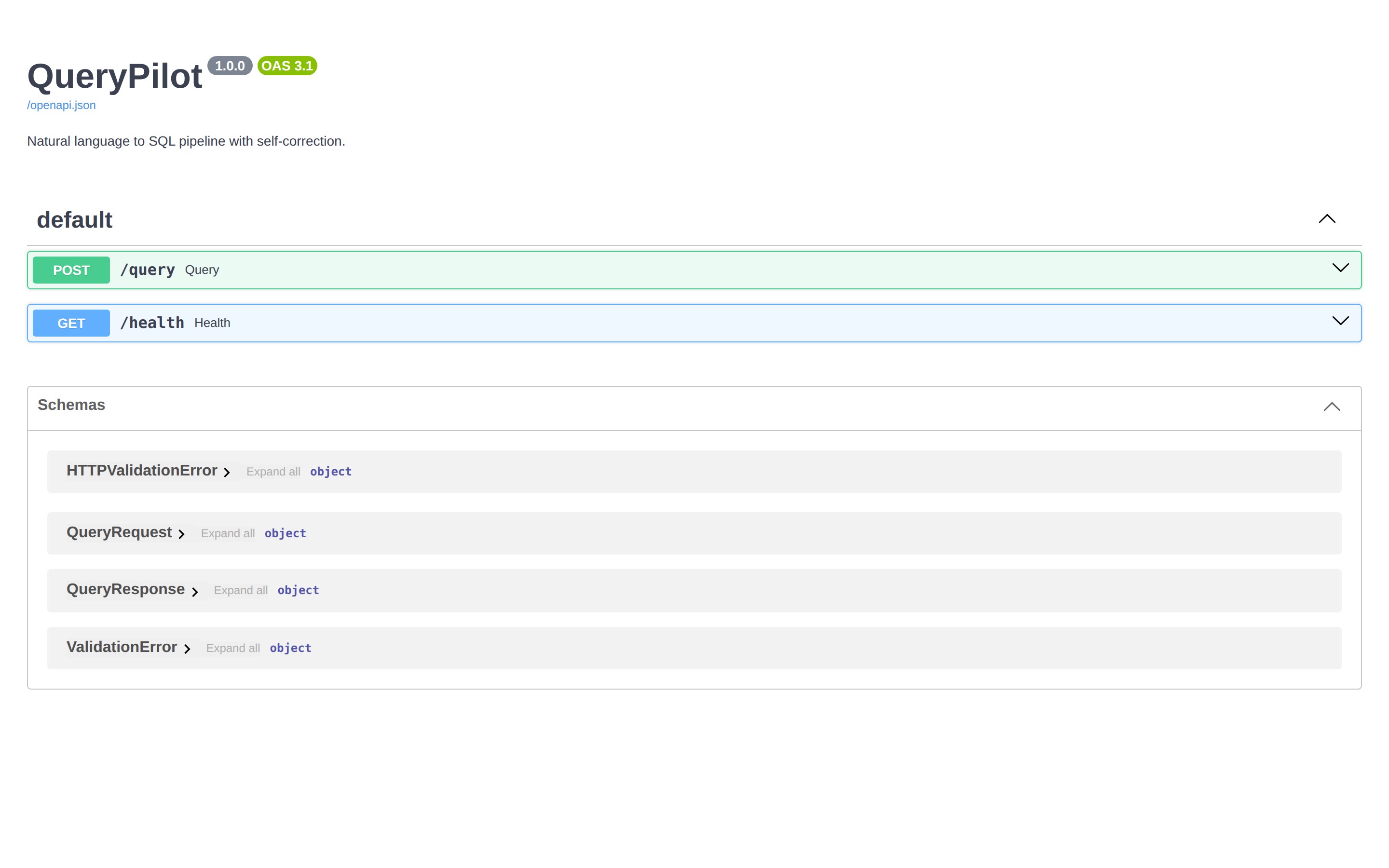
- The API capture proves the served interface, not that every endpoint or external deployment is currently available.
Deliberate boundaries
- Describe execution success as semantic accuracy.
- Combine the core and adversarial denominators into one lift claim.
Semantic answer review
Add gold results or human review so execution success can be separated from whether the query answered the intended business question.
Safety-preserving correction
Expand tests where a syntax fix changes sensitive intent, table access, or the meaning of a previous rejection.
Inspectable trace export
Persist schema context, rejected SQL, failure feedback, corrected SQL, and result in one publication-safe trace artifact.
10 / Stack and sources
The systems underneath it, and where this account comes from.
- Python
- FastAPI
- LangGraph
- PostgreSQL
- ChromaDB
- Docker
Audited internallyQueryPilot committed repository and Day 6 evaluation
Audited internallyReal served API capture